Responsible sourcing
Wesbeam works with certified Australian timber supply chains and forestry partners to support responsible, traceable and renewable wood resources.
Wesbeam works with certified Australian timber supply chains and forestry partners to support responsible, traceable and renewable wood resources.
We are committed to full utilisation of every log. Manufacturing residues such as bark, chips and offcuts are repurposed into useful products wherever possible.
Timber stores carbon for the life of the structure. Choosing Australian-made engineered timber can help project teams reduce reliance on more carbon-intensive materials and support sustainable design outcomes.
Local sourcing and manufacturing support Australian jobs, reduce transport requirements and strengthen the domestic building materials supply chain.
An Environmental Product Declaration (EPD) is a bit like a nutrition label for a building product.
It provides clear, standardised and independently verified information about a product’s environmental impact across its entire life cycle, from raw materials and manufacturing through to use and end-of-life.
Rather than relying on marketing claims, an EPD gives you real, comparable data you can trust, so you can build with confidence.
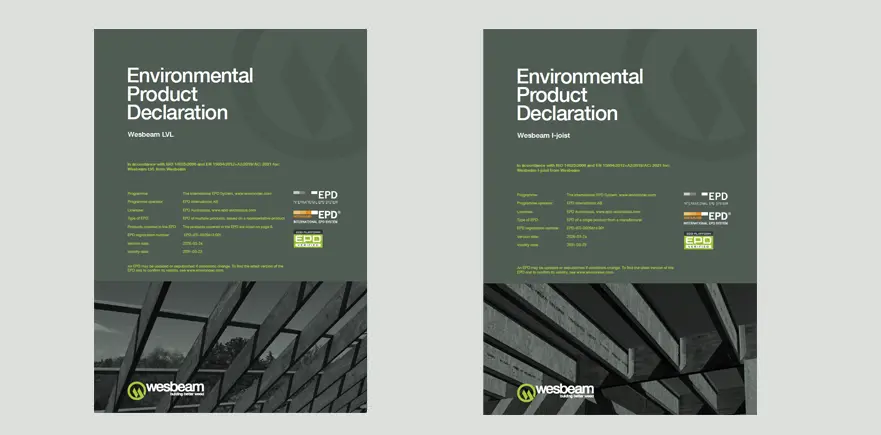
Wesbeam LVL and I-joist products now come with Environmental Product Declarations (EPDs) - providing independently verified environmental impact data, ready to use when it matters most.
EPDs give you a clear, standardised view of a product’s environmental performance across its entire life cycle - from raw materials and manufacturing, through to use and end-of-life.
So instead of relying on assumptions or marketing claims, you get credible data you can trust.
What does an EPD tell me?
An EPD shows you exactly what goes into a product and the impact it has on the environment, including:
Carbon footprint
Energy and resource use
Emissions to air, soil and water
Waste and end-of-life outcomes
Clarity you can trust
Transparent, third-party verified data, so you know exactly what you’re getting.
Fair comparison
All EPDs follow the same rules, so you can compare products on a level playing field.
Better-informed decisions about environmental impact
Make more informed choices, especially when it comes to reducing embodied carbon.
Stronger tenders and compliance
EPDs are increasingly required in tenders and recognised by rating tools like Green Star.
The full picture
From production through to end-of-life, EPDs reveal impacts that are often overlooked or misunderstood.
Global credibility
EPDs are publicly available and internationally recognised, giving confidence across markets.
Meet Green Building standards
EPDs are increasingly required by green building certification schemes like Green Star and NABERS.
They support achieving points in materials credits and provide data for life cycle assessments and carbon calculators.
Make more sustainable material choices
The transparent information of an EPD helps evaluate the life cycle impacts of materials, such as embodied carbon, energy use, and resource depletion. Builders, architects, engineers and specificers can use this data in embodied carbon calculators or project Life Cycle Assessments and they can select materials that align with their sustainability goals.
Benchmarks and improvement
EPDs provide a snapshot of the environmental impact of our products at the date of publication and allow us to show how we improve these impacts over time in subsequent published EPDs.
Improving communications
EPDs allow us to communicate the environmental impacts of our products to our customer.
Government regulations
In Australia, state emissions reduction plans are boosting sustainable construction. The government’s Environmentally Sustainable Procurement (ESP) Policy preferences EPDs for reporting on emissions reductions. Tools like NABERS’ Embodied Carbon rating promote product-specific EPDs.